System Seven Repair Guide
System Seven is the 7-way trailer connector that carries lights, brakes, and aux power between tractor and trailer. Here is what goes wrong and how a shop repairs it.
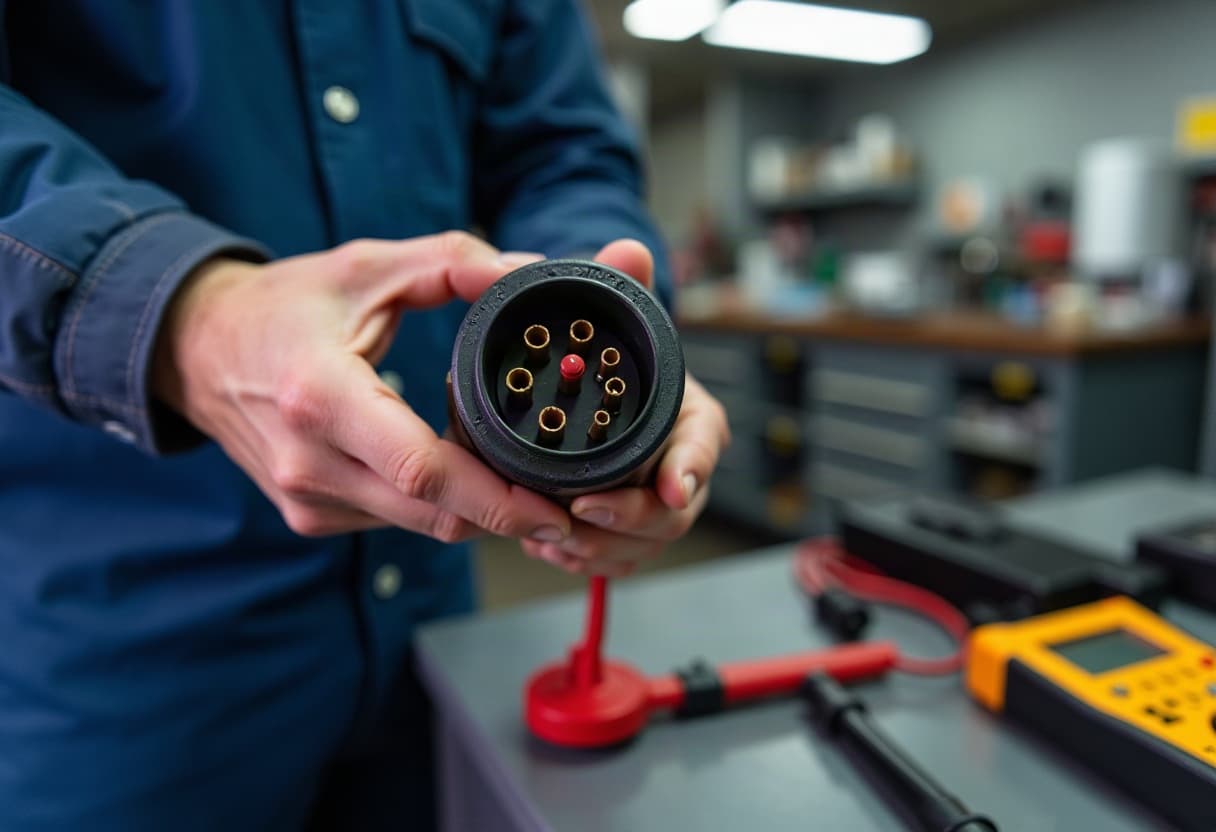
If you haul trailers in the Seattle and Tacoma corridor, the small plug on the back of your tractor carries more responsibility than its size suggests. System Seven is the 7-way electrical connector that bridges the tractor and trailer, and when it fails the truck stops earning. Brake lights go dark, ABS codes trip the dash, and a single corroded pin can put a trailer out of service at a weigh station. This guide covers what System Seven is, why it fails, and how a truck repair shop handles the repair.
What System Seven Actually Is
System Seven is the industry shorthand for the 7-way trailer connector built to the SAE J560 standard. It is the round plug on the back of every Class 8 tractor, with seven flat pins arranged around a center pin. Each pin carries a defined circuit:
- Tail and clearance lights (running lights)
- Left turn signal
- Right turn signal
- Stop lights (brake application)
- Backup lights (reverse)
- 12-volt auxiliary power (center pin, hot when the key is on)
- ABS signal (the trailer's antilock brake communication line)
The 7-way is what lets the tractor talk to the trailer. When any of those pins loses continuity, the trailer stops responding correctly. A bad ground on the running light circuit dims every marker light at once. A failed ABS pin trips a trailer ABS code and can put a driver out of service at an inspection.
Why System Seven Fails
The 7-way connector sits at the dirtiest, wettest, most vibration-prone point on the truck. Road spray, salt, and temperature swings hit it every mile. The failures fall into a handful of patterns.
Pin corrosion. Moisture wicks into the plug where the pins meet the socket. Green or white corrosion builds up on the contact faces and adds resistance. The circuit still reads voltage on a meter with no load, but under the amperage of a full set of trailer lights the voltage collapses. This is why a meter alone is not enough.
Pin spread and bent pins. Coupling the trailer at an angle, or slamming the plug in by the cord, bends the flat pins. Once a pin is bent or the socket contacts spread, the connection goes intermittent. The driver sees lights flicker over bumps and assumes the bulb is bad.
Wire fatigue. The harness flexes where it leaves the back of the cab and again at the plug. Vibration and constant bending break strands inside the insulation. The outside looks fine, the inside is open. A chafed wire shorting to the frame can also blow the fuse for the entire lighting circuit at once.
Ground failures. The 7-way relies on a clean chassis ground on both the tractor and trailer side. A loose or corroded ground strap is the most common cause of every marker light dimming at once, or of brake and turn signals back-feeding into the wrong circuit. Many shops replace bulbs and fuses chasing a problem that was the ground all along.
ABS circuit faults. The ABS pin on the 7-way carries the trailer's antilock communication. A break on this pin puts the trailer ABS lamp on and triggers a code. On newer trailers with roll-stability systems, an ABS fault can derate the truck.
How a Shop Diagnoses a 7-Way Fault
Diagnosis is what separates a real repair from a parts swap. The process at a competent shop runs roughly like this.
First, the technician puts a 7-way circuit tester on the tractor output. This shows immediately whether the tractor side is delivering voltage to every pin under load. If the tester shows all circuits good, the fault is on the trailer side. If it shows a missing circuit, the fault is on the tractor side.
Next, voltage drop testing on the ground circuit. A clean ground should drop less than 0.1 volts under load. Anything higher than that points to a bad ground connection somewhere between the plug and the chassis.
Then a visual inspection of the trailer side plug. Corroded pins, spread sockets, melted plastic, and frayed wires where the cord meets the plug are all visible to a trained eye. The plug gets pulled apart and the wire ends get checked for green corrosion creeping up inside the insulation.
Only after the fault is isolated does the shop replace parts. A shop that replaces the plug first and asks questions later is billing you for guesswork.
What the Repair Involves
The actual repair depends on what the diagnosis found. The most common repair is replacing the 7-way plug end on the trailer cord. The old plug comes off, the wire ends get trimmed back to clean copper, the new plug gets wired to the correct pins, and the connections get sealed with heat-shrink to keep moisture out.
When the corrosion has crept up the cord, the shop splices in a section of new cord or replaces the cord entirely. When the fault is on the tractor side, the diagnosis traces back through the harness to a fuse, a relay, the trailer brake controller, or a broken wire at the back of the cab. A failed ground gets cleaned, re-secured, and treated with corrosion inhibitor.
For ABS circuit faults, the diagnosis has to confirm whether the break is on the 7-way pin itself or deeper in the trailer ABS module's wiring. Replacing the plug without finding the actual break just sends the truck back out with the same code.
Why This Belongs at a Truck Repair Shop
A 7-way connector looks simple, and a driver can change a plug end in a parking lot. The hard part is knowing whether the plug was the problem. Electrical diagnostics on a commercial truck means working backward from the symptom, not forward from the easiest part to swap. A shop that does truck electrical repair has the testers, the wiring diagrams, and the experience to tell a tractor-side fault from a trailer-side fault before any money gets spent on parts.
That matters because the wrong diagnosis turns a $40 plug into a $400 goose chase. A fleet that keeps getting the same trailer ABS code back after every plug replacement is paying for the same misdiagnosis on repeat.
Preventing 7-Way Failures
The cheapest repair is the one you prevent. During a normal preventive maintenance inspection, the 7-way plug should get checked for corrosion, bent pins, and a clean ground. A quick shot of dielectric grease on the pins keeps moisture out between hookups. Catching a green-tinted pin during a PM costs a fraction of what a roadside lighting failure on I-5 costs in tow, downtime, and a missed delivery window.
Trailer cords also take abuse from being dropped on the ground between hookups. A hanging cord rack on the trailer, or at minimum a clean place to set the plug, keeps the contact faces off the dirt and out of the puddles.
Local Reality: Sumner and the SR-167 Corridor
Emerald Fleet Services is family-owned and based at 15022 Puyallup St #101 in Sumner, WA, on the SR-167 corridor with straight runs to I-5, the Port of Tacoma, and the warehouse districts around Auburn, Kent, and Puyallup. We run electrical diagnostics on commercial trucks at our Sumner shop, and we run mobile roadside repair across the Seattle and South Sound region for faults that do not need a lift.
For an owner-operator running freight through the Puget Sound, the difference between a shop that diagnoses the 7-way fault correctly and one that swaps the plug and hopes is the difference between a truck back on the road in an afternoon and the same trailer ABS code coming back next week. If you are seeing trailer lighting faults, ABS codes, or intermittent brake signals on a rig running through the Greater Seattle area, contact us or call (253) 321-1828. We handle electrical diagnostics, mobile roadside repair, and the broader heavy-duty truck repair work that keeps a fleet moving. For more on the wider shop visit, our diesel repair guide walks through what to look for when you drop a truck off.
A 7-way connector is small, cheap, and easy to ignore until the night it puts a trailer out of service. Treating System Seven as part of the maintenance schedule, not just the repair list, is how operators in the Seattle area keep their cost per mile down and their trucks on the road.
Frequently asked questions
What is a System Seven on a semi truck?+
System Seven refers to the 7-way electrical connector, built to the SAE J560 standard, that links the tractor's lighting, brake, and auxiliary circuits to the trailer. It carries tail, clearance, stop, turn, backup, and ABS signals plus a 12-volt auxiliary feed.
What are the most common System Seven repair issues?+
The most common issues are corroded pins inside the plug, broken or bent pins from coupling at an angle, frayed wires where the harness flexes near the back of the cab, failed ground connections, and a damaged ABS circuit that puts the trailer into a fault state.
How does a truck repair shop diagnose a 7-way connector problem?+
A shop uses a 7-way circuit tester on the tractor output, checks voltage at each pin under load, performs a voltage drop test on the ground circuit, and inspects the trailer side plug for corrosion and pin spread. The diagnosis separates a tractor-side fault from a trailer-side fault before any parts are replaced.
Can a System Seven repair be done on the roadside?+
Many 7-way faults can be handled on the roadside, including plug replacement, broken wire repair, and ground cleaning. Faults that require full electrical diagnostics or harness replacement are better handled at the shop where the circuit can be traced end to end.